hv_approx#
- moocore.hv_approx(points, /, ref, *, maximise=False, nsamples=262144, seed=None, method='Rphi-FWE+')[source]#
Approximate the hypervolume indicator.
Approximate the value of the hypervolume metric with respect to a given reference point assuming minimization of all objectives. Methods
"Rphi-FWE+"and"DZ2019-HW"are deterministic and ignore the parameterseed, whilemethod="DZ2019-MC"relies on Monte-Carlo sampling [1]. All methods tend to get more accurate with higher values ofnsamples, but the increase in accuracy is not monotonic as shown in the example Comparing methods for approximating the hypervolume.Monte-Carlo sampling uses PCG64. Seeded results differ from earlier moocore versions and from NumPy’s seed initialization.
See also
For details of the calculation, see the Notes section below.
- Parameters:
points (
ArrayLike) – 2D array of numerical values, where each row gives the coordinates of a point in objective space. If the array is created by theread_datasets()function, remove the last column.ref (
ArrayLike) – Reference point as a 1D vector. Must be either a single value, which will be used for all coordinates, or the same length as a single point inpoints.maximise (
bool|Sequence[bool|int] |NDArray[bool]) – Whether the objectives must be maximised instead of minimised. Either a single boolean value that applies to all objectives or a list of boolean values, with one value per objective. Also accepts a 1D array with values 0 or 1 for each objective. (default:False)nsamples (
int) – Number of samples for Monte-Carlo sampling. Higher values typically produce more accurate approximations of the true hypervolume, but require more time. (default:262144)seed (
int|Generator|None) – Either an integer to seednumpy.random.default_rng(), a Numpy default random number generator (RNG) or an instance of a Numpy-compatible RNG.Noneuses the equivalent of a random seed, as innumpy.random.default_rng(). (default:None)method (
'DZ2019-HW'|'DZ2019-MC'|'Rphi-FWE+') – Method to approximate the hypervolume. (default:'Rphi-FWE+')
- Returns:
float– A single numerical value, the approximate hypervolume indicator.
See also
Notes
All available methods approximate the hypervolume as a \((m-1)\)-dimensional integral over the surface of hypersphere [1]:
\[\widehat{HV}_r(A) = \frac{2\pi^\frac{m}{2}}{\Gamma(\frac{m}{2})}\frac{1}{m 2^m}\frac{1}{n}\sum_{i=1}^n \max_{y \in A} s(w^{(i)}, y)^m\]where \(m\) is the number of objectives, \(w^{(i)}\) are weights uniformly distributed on \(S_{+}\), i.e., the positive orthant of the \((m-1)\)-D unit hypersphere, \(n\) is the number of weights sampled, \(\Gamma()\) is the gamma function
math.gamma(), i.e., the analytical continuation of the factorial function, and \(s(w, y) = \min_{k=1}^m (r_k - y_k)/w_k\).In the default
method="Rphi-FWE+"[2], the weights \(w^{(i)}, i=1\ldots n\) are defined using the deterministic low-discrepancy sequence \(R_\phi\) [3] mapped to the positive orthant of the hypersphere using a modified version of Fang and Wang efficient mapping [4].In
method="DZ2019-HW"[1], the weights \(w^{(i)}, i=1\ldots n\) are defined using a deterministic low-discrepancy sequence. The weight values depend on their number (nsamples), thus increasing the number of weights may not necessarily increase accuracy because the set of weights would be different.In
method="DZ2019-MC"[1], the weights \(w^{(i)}, i=1\ldots n\) are sampled from the unit normal vector such that each weight \(w = \frac{|x|}{\|x\|_2}\) where each component of \(x\) is independently sampled from the standard normal distribution [5].The original source code in C++/MATLAB for both
"DZ2019-HW"and"DZ2019-MC"methods can be found here.López-Ibáñez[2] empirically shows that
"Rphi-FWE+"typically produces an approximation error as low as the other methods, with a computational cost similar to"DZ2019-MC"and significantly faster than"DZ2019-HW".References
Examples
>>> x = np.array([[5, 5], [4, 6], [2, 7], [7, 4]])
>>> moocore.hypervolume(x, ref=[10, 10])
38.0
>>> moocore.hv_approx(x, ref=[10, 10], method="Rphi-FWE+")
37.99998
>>> moocore.hv_approx(x, ref=[10, 10], method="DZ2019-HW")
37.99996
>>> moocore.hv_approx(x, ref=[10, 10], seed=42, method="DZ2019-MC")
38.00155
Merge all the sets of a dataset by removing the set number column:
>>> x = moocore.get_dataset("input1.dat")[:, :-1]
Dominated points are ignored, so this:
>>> moocore.hv_approx(x, ref=10)
93.5533
>>> moocore.hv_approx(x, ref=10, method="DZ2019-HW")
93.5533
gives the same hypervolume approximation as this:
>>> x = moocore.filter_dominated(x)
>>> moocore.hv_approx(x, ref=10)
93.5533
>>> moocore.hv_approx(x, ref=10, method="DZ2019-HW")
93.5533
The approximation is far from perfect for large number of dimensions:
>>> x = moocore.get_dataset("ran.10pts.9d.10")[:, :-1]
>>> x = moocore.filter_dominated(-x, maximise=True)
>>> x = moocore.normalise(x, to_range=[1, 2])
>>> reference = 0.9
>>> moocore.hypervolume(x, ref=reference, maximise=True)
0.483633123747
>>> moocore.hv_approx(x, ref=reference, maximise=True)
0.48397532301
>>> moocore.hv_approx(x, ref=reference, maximise=True, method="DZ2019-HW")
0.483083547763
Gallery examples#
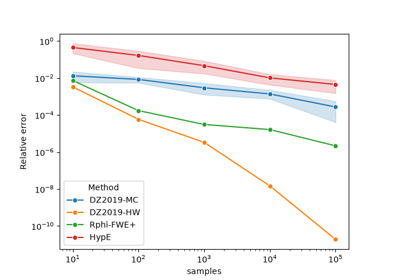
Comparing methods for approximating the hypervolume