Single-point crossover#
single_point_crossover() draws a cut point and exchanges the
tails of the two parents. pymoo (SinglePointCrossover), DEAP
(cxOnePoint) and DESDEO (SinglePointBinaryCrossover) provide the
same operator. The operator of DESDEO only accepts binary variables, so all
packages cross over binary parents here: a parent of zeros and a parent of ones
in the KS tests, and random binary parents in the timings.
KS test results#
moocore |
pymoo |
deap |
desdeo |
|
|---|---|---|---|---|
moocore |
0.995 |
0.996 |
0.650 |
|
pymoo |
0.995 |
0.531 |
0.422 |
|
deap |
0.996 |
0.531 |
0.177 |
|
desdeo |
0.650 |
0.422 |
0.177 |
All implementations produce the same distribution of offspring.
Performance over number of parents#
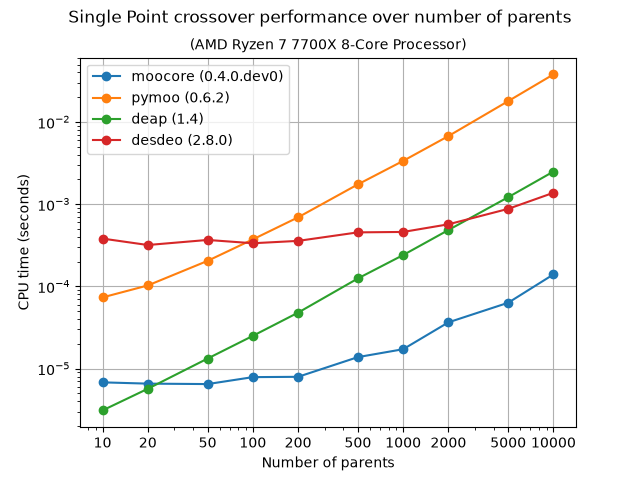
With 10 and 20 parents, DEAP is faster than moocore. From 50 parents on, moocore is the fastest. With 10 000 parents, it takes 0.14 ms, while DESDEO, DEAP and pymoo take 9.8, 18 and 270 times as long.
Performance over number of variables#
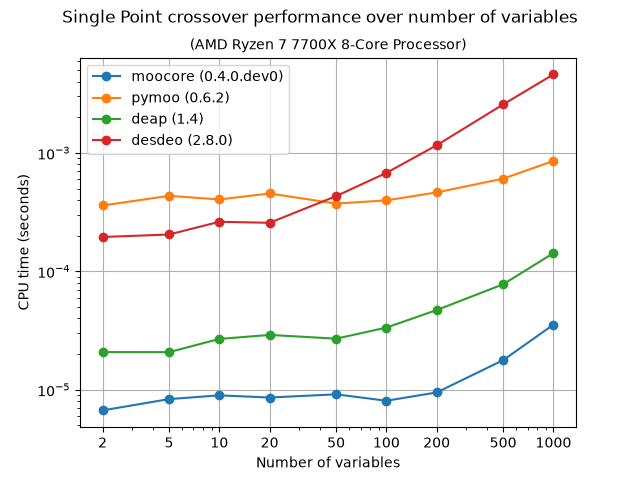
moocore is the fastest for every number of variables. DEAP takes 2.5 to 5 times as long, and pymoo and DESDEO take 24 to 144 times as long.