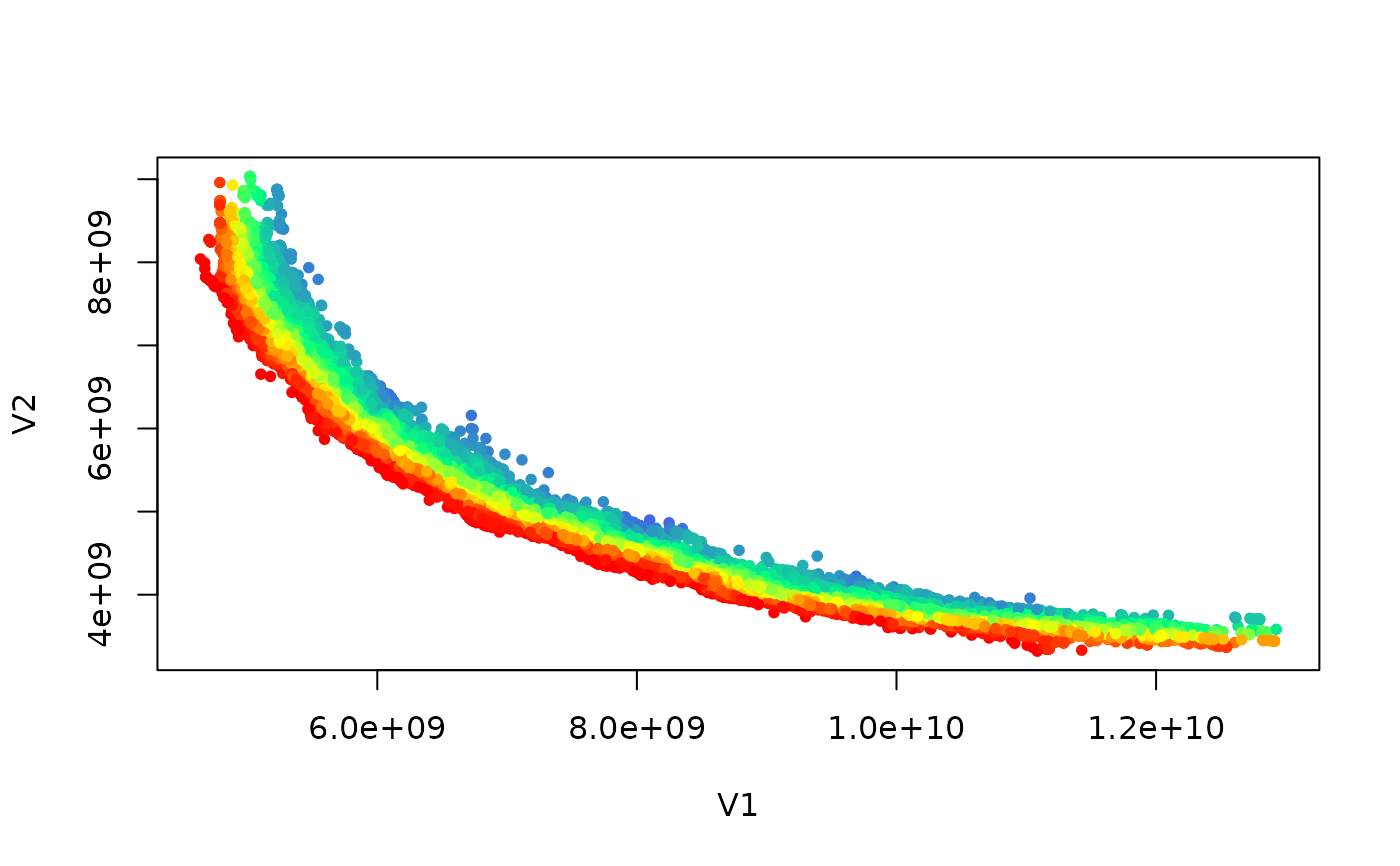
Rank points according to Pareto-optimality (nondominated sorting).
Source:R/nondominated.R
pareto_rank.Rdpareto_rank() is meant to be used like rank(), but it assigns ranks
according to Pareto dominance, where rank 1 indicates those solutions not
dominated by any other solution in the input set. Duplicated points are
assigned the same rank. The resulting ranking can be used to partition
points into a list of matrices, each matrix representing a nondominated
front (Deb et al. 2002)
(see examples below).
Arguments
- x
matrix()|data.frame()
Matrix or data frame of numerical values, where each row gives the coordinates of a point.- maximise
logical()
Whether the objectives must be maximised instead of minimised. Either a single logical value that applies to all objectives or a vector of logical values, with one value per objective.
Value
An integer vector of the same length as the number of rows of the
input x with values within [1, nrow(points)], where each value gives
the rank of each point (lower is better).
Details
Given \(x,y \in\mathbb{R}^m\), let \(x \prec y\) denote that \(x\) dominates \(y\) according to Pareto optimality.
Nondominated sorting, also called the layers-of-maxima problem (Buchsbaum and Goodrich 2004) , partitions a finite set of points \(X \subset \mathbb{R}^m\) into an ordered sequence of fronts, \(F_1, F_2, \dots, F_k\), where \(1 \leq k \leq |X|\), satisfying the following conditions:
All points are allocated to a front: $$\bigcup_{i=1}^{k} F_i = X$$
Each point is allocated to only one front: $$F_i \cap F_j = \emptyset,\; \forall i,j \in \{1,2,\dots,k\},\, i \neq j$$
Points within a front are mutually nondominated: $$\nexists x,y \in F_i,\; x \prec y,\; \forall i\in\{1,2,\dots,k\}$$
The first front contains points not dominated by any other point: $$\forall y \in F_1,\; \nexists x \in X,\; x \prec y$$
Every point in front \(i\) is dominated by at least one point in front \(i-1\): $$\forall y \in F_i,\; \exists x \in F_{i-1},\; x \prec y,\; \forall i\in\{2,3,\dots,k\}$$
The rank returned by pareto_rank() is the index \(i \in
\{1,2,\dots,k\}\) of the front \(F_i\) allocated to each point. If all
points are mutually nondominated, there is only one front (\(k = 1\)). If
each front contains one point, then \(k = n = |X|\).
With \(m=2\), i.e., ncol(data)=2, the code uses the best-known \(O(n
\log n)\) algorithm by Jensen (2003)
. When \(m \geq 3\), it uses the naive
algorithm that identifies one front at a time, which requires
\(O(n^2\log n)\) for \(m=3\), and \(O(n^2 \log^{m-2} n)\) for \(m
\geq 4\).
References
A
L Buchsbaum, M
T Goodrich (2004).
“Three-Dimensional Layers of Maxima.”
Algorithmica, 39, 275–289.
doi:10.1007/s00453-004-1082-5
.
Kalyanmoy Deb, A Pratap, S Agarwal, T Meyarivan (2002).
“A fast and elitist multi-objective genetic algorithm: NSGA-II.”
IEEE Transactions on Evolutionary Computation, 6(2), 182–197.
doi:10.1109/4235.996017
.
M
T Jensen (2003).
“Reducing the run-time complexity of multiobjective EAs: The NSGA-II and other algorithms.”
IEEE Transactions on Evolutionary Computation, 7(5), 503–515.
doi:10.1109/TEVC.2003.817234
.
Examples
three_fronts = matrix(c(1, 2, 3,
                        3, 1, 2,
                        2, 3, 1,
                        10, 20, 30,
                        30, 10, 20,
                        20, 30, 10,
                        100, 200, 300,
                        300, 100, 200,
                        200, 300, 100), ncol=3, byrow=TRUE)
pareto_rank(three_fronts)
#> [1] 1 1 1 2 2 2 3 3 3

split.data.frame(three_fronts, pareto_rank(three_fronts))
#> $`1`
#>      [,1] [,2] [,3]
#> [1,]    1    2    3
#> [2,]    3    1    2
#> [3,]    2    3    1
#>
#> $`2`
#>      [,1] [,2] [,3]
#> [1,]   10   20   30
#> [2,]   30   10   20
#> [3,]   20   30   10
#>
#> $`3`
#>      [,1] [,2] [,3]
#> [1,]  100  200  300
#> [2,]  300  100  200
#> [3,]  200  300  100
#>
path_A1 <- file.path(system.file(package="moocore"),"extdata","ALG_1_dat.xz")
set <- read_datasets(path_A1)[,1:2]
ranks <- pareto_rank(set)
str(ranks)
#>  int [1:23260] 13 24 20 22 22 5 23 5 16 20 ...
if (requireNamespace("graphics", quietly = TRUE)) {
   colors <- colorRampPalette(c("red","yellow","springgreen","royalblue"))(max(ranks))
   plot(set, col = colors[ranks], type = "p", pch = 20)
}